




Free written scope consultation - allowances, timeline, and change-order rules on paper before a single trade is scheduled
Silestone Fence Installation: The Orange County Owner’s Guide
Silestone fence installation in Orange County typically runs between $3,500 and $9,000, depending on the fence length, substrate condition, and whether we’re setting new posts or tying into an existing run. Most owners discover they need this work when a wind event or soil shift exposes a problem: a cracked panel, a leaning post, or a fence section that’s started to separate from its footing. You’ve got a Silestone product integrated into your outdoor space, and the fence component has failed. We stock Silestone-compatible fence parts and install them with the same by-the-book discipline we bring to every job.
Here’s the straight picture. Silestone is a quartz surface, engineered in Spain, and when it’s used in fence applications around Orange County, it’s typically as a decorative panel, privacy screen, or post cladding. The failure point is almost never the Silestone itself. It’s what the Silestone is mounted to: the substrate, the posts, the hardware. In Anaheim Hills, we see wind-driven movement stress the panel connections. Near the coast in Newport and Huntington Beach, salt air corrodes the hardware over time. Inland, in Irvine and Tustin, expansive clay soil shifts posts and puts pressure on rigid panels until something cracks.
This page covers what fails first, what it costs to fix it right, and what we stock on the truck so we’re not guessing when we show up. We are an independent contracting company. We are not affiliated with Silestone, and we don’t claim to be. We work with the product, we know its specs, and we install against the manufacturer’s requirements.
Which Silestone Models This Applies To

Silestone fence panels and post cladding come in the same quartz formulations as their countertop lines, with thicknesses that matter. Most fence applications use 2cm or 3cm slabs, cut to panel dimensions, and the color series tells you something about the material’s makeup. The Eternal Series, Sunlit Days, and Le Chic lines all carry the standard Silestone hardness profile, but the fabrication spec for outdoor fence use is different from what you’d put on a kitchen island. Outdoor panels need a UV-stable resin, and not every Silestone color is rated for prolonged sun exposure.
The compatibility gotcha most owners miss: Silestone fence panels are cut from full slabs, and the panel’s edge profile and corner treatment are specific to the fabricator who originally cut them. If a panel cracks and you order a replacement slab section without matching the edge profile, the seam will never look right. We note the edge profile, the corner radius, and the mounting hole pattern before we order anything. We also confirm the thickness. A 2cm panel on a fence that gets direct wind exposure will flex more than a 3cm panel, and flex is what kills the adhesive bond and the mounting gaskets.
When we quote a Silestone fence installation in Orange County, we specify OEM Silestone material when the original fabricator’s cut records are available. When they’re not, we use a quality aftermarket quartz panel matched to the same color code and thickness. The aftermarket option usually saves 15 to 20 percent on material, and for most fence applications it performs identically. The difference is traceability. OEM gives you a factory run number tied to the color batch. Aftermarket gives you a close color match but not a guaranteed exact one. We show both options with the price difference in writing, and you decide.
Styles & brands we work with







Signs Your Silestone Fence Installation Is Failing
- Panel cracks spidering from a mounting point. This is the classic failure. The hole was drilled too close to the panel edge, or the fastener was over-torqued, and vibration from wind turned a hairline into a split. The fix is a new panel section, not a patch.
- Fence post leaning or pulling away from the panel. In Orange County, especially in the clay soils of Yorba Linda and Fullerton, posts move with seasonal moisture. When the post moves and the Silestone panel doesn’t, the mounting hardware takes the strain and eventually fails.
- Panel rattling against the post in wind. The rubber grommets or isolation pads have broken down. In coastal areas, salt accelerates this. A rattling panel is a warning sign, not a nuisance. Let it go and the panel edge starts chipping against the post face.
- Discoloration or chalky residue along the panel edges. That’s UV degradation of the resin near the exposed edges, and it’s more common on certain color lines than others. It doesn’t mean the panel is about to break, but it tells you the material was not the right spec for that placement.
- Gap opening between the Silestone panel and the substrate board. The adhesive has released, usually from water intrusion behind the panel. Once water gets behind quartz, freeze-thaw cycles aren’t the issue here, but trapped moisture will rot the substrate and the panel will eventually fall.
See the difference
 Before
 After
After Before
 After
After Before
 After
AfterReplacement Cost & What’s Included
You’re looking at $3,500 to $9,000 for a Silestone fence installation in Orange County, and most jobs land in the $4,500 to $6,500 range. The spread comes down to three things: how many linear feet of fence we’re working with, whether the existing posts are sound or need to be reset, and the panel thickness and color series you’re matching.
Here’s the breakdown we put on every written quote, so you can see exactly where the money goes:
- Silestone panel material: $1,200 to $3,200, depending on footage, thickness, and OEM versus aftermarket.
- Posts and substrate: $800 to $2,400. This covers pressure-treated or steel posts, a backer board rated for exterior use, and the isolation pads and grommets that prevent the panel from cracking.
- Labor and installation: $1,500 to $3,400. Includes post setting, panel mounting, edge sealing, and cleanup.
Every quote includes the written price before work starts, and that number does not move at the door. If the scope changes mid-job, which is rare, you get a change order in writing before we proceed. The work carries our 365-Day Done Right Promise: if the fence fails within a year of installation, we come back and correct it at no charge. That’s the Garrison Standard. It’s not a courtesy. It’s the way we’ve operated since 2004.
DIY or Call Us?
There are two things you can do safely on your own. First, take photos of the failure from multiple angles, including close-ups of the mounting points and any cracks. Second, measure the panel dimensions and note the thickness if you can see the edge. That information tells us a lot before we even schedule a walk.
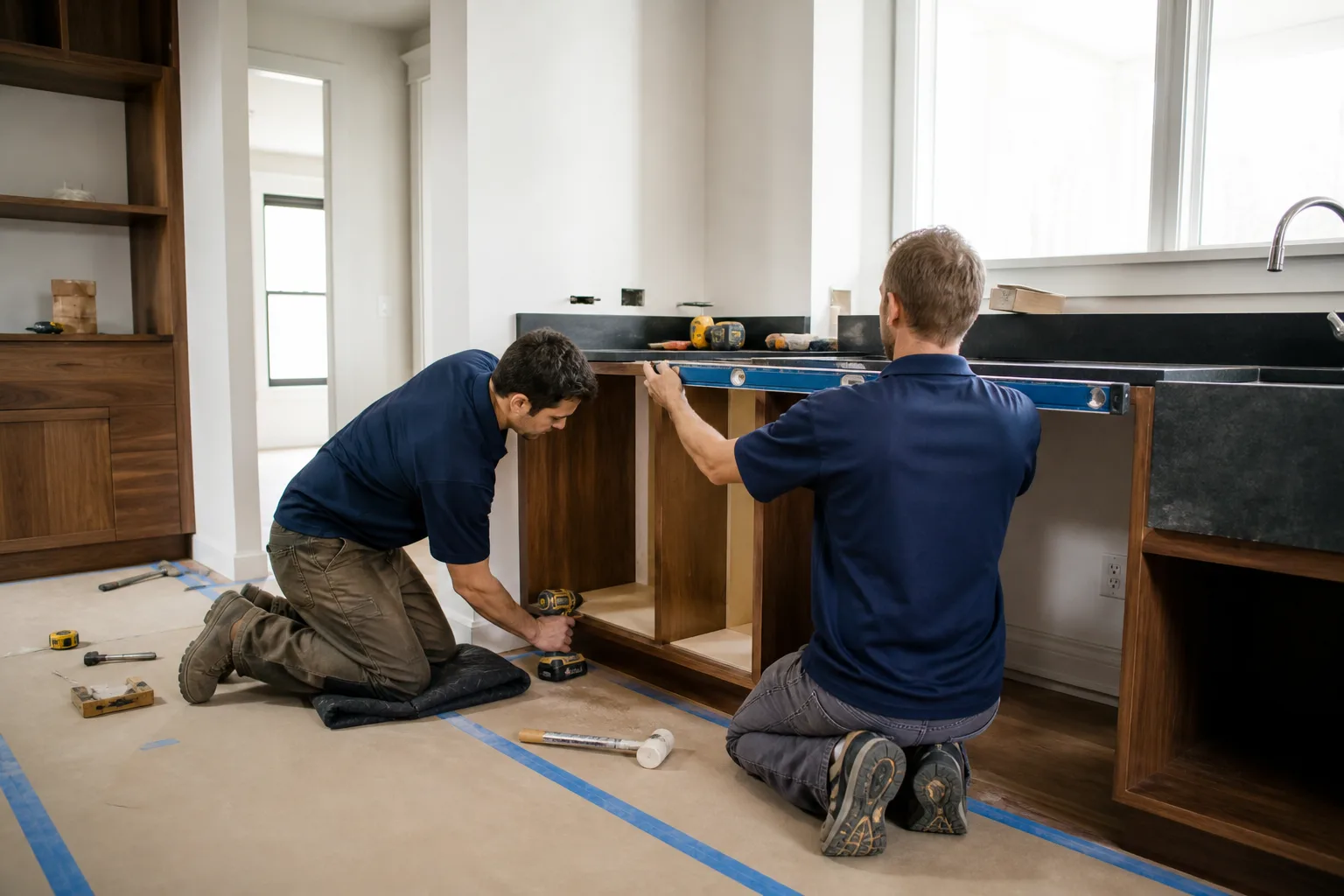
What you should not do is attempt to remove a cracked Silestone panel yourself. Quartz is heavy. A 3cm panel measuring four feet by three feet can weigh over 200 pounds, and when quartz breaks, the edges are sharp enough to send someone to urgent care. The panel is under tension from the mounting hardware, and releasing that tension without the right bracing and support is how people get hurt. We use panel lifters and two-person minimum crews on every fence installation. It’s not about being cautious. It’s about doing the job without incident.
If the panel is loose or the post is leaning, that’s also a matter for a crew. A leaning post usually means the footing has failed, and resetting a post in Orange County soil needs to be done to the depth and width that matches your local conditions. Short of that, you’ll be back here in a year with the same problem. Call (562) 262-2907 and we’ll get someone out to look at it. Straight number, clear scope, no surprises at final invoice.
FAQs
How long does a Silestone fence installation last in Orange County? A properly installed Silestone fence panel system lasts 20 to 30 years in our climate, with the substrate and hardware typically failing before the quartz itself. Coastal salt air can shorten hardware life to 10 to 15 years if the original installer used standard fasteners instead of marine-grade. Call (562) 262-2907 if you want us to inspect what’s on your fence now; if it’s the hardware, the panel may still be fine.
Can a cracked Silestone fence panel be repaired instead of replaced? No, not in a way that holds in an exterior application. Quartz can be filled and polished in a controlled countertop setting, but an outdoor fence panel takes wind load and thermal movement, and any filled crack will re-open. The honest fix is panel replacement. We’ll quote the replacement at a written price before we start. Call (562) 262-2907 with the panel dimensions and we’ll get you a number.
How long does the swap take? A standard Silestone fence panel replacement with sound posts takes one full day on site, sometimes two if we’re resetting posts or pouring new footings. We don’t rush concrete cure times, because that’s how you end up doing the job twice. Call (562) 262-2907 and we’ll give you a schedule that accounts for your specific job.
Do you stock Silestone fence components on the truck? We stock the installation hardware on every truck: marine-grade fasteners, isolation grommets, edge sealant, and the substrates we use for exterior quartz. The Silestone panels themselves are cut to order for your specific dimensions and color code, which typically takes five to seven business days from the fabricator. Call (562) 262-2907 and we’ll confirm current lead times before you commit.
If you’ve got a Silestone fence that’s failing anywhere in Orange County, from Anaheim Hills to Balboa Island, call our office at (562) 262-2907. We’ll send a background-checked, uniformed crew to assess it, put the scope and price in writing, and stand behind the work for a full year. That’s how Curtis Lane runs every job: the same discipline on a fence panel that we bring to a whole-home remodel.
Written by Curtis Lane, Owner, Bradford Remodeling Co – Orange County at Bradford Remodeling Co Orange County, serving Orange County and nearby areas.


