
Free written scope consultation - allowances, timeline, and change-order rules on paper before a single trade is scheduled
Oldcastle Home Additions & ADU: The Orange County Owner’s Guide
If you’re researching Oldcastle home additions or an ADU in Orange County, you’re likely weighing a $45,000 to $130,000 investment and want straight answers on what it actually takes. We install Oldcastle-compatible addition and ADU projects throughout Orange County, with written pricing locked before any work begins. Most Orange County homeowners reach this page because they’ve bought a property with an existing Oldcastle addition that’s showing its age, or they’re planning new square footage and want to understand what the product line can and can’t do.
Oldcastle is a major building products manufacturer, but when homeowners talk about “Oldcastle home additions,” they’re usually referring to additions built with Oldcastle concrete block, pavers, or precast wall systems, or to modular/panelized additions sourced through an Oldcastle distribution channel. The distinction matters because it changes how you match materials, how you tie into existing framing, and how you price the project. We’ll walk you through all of it.
Which Oldcastle Models This Applies To
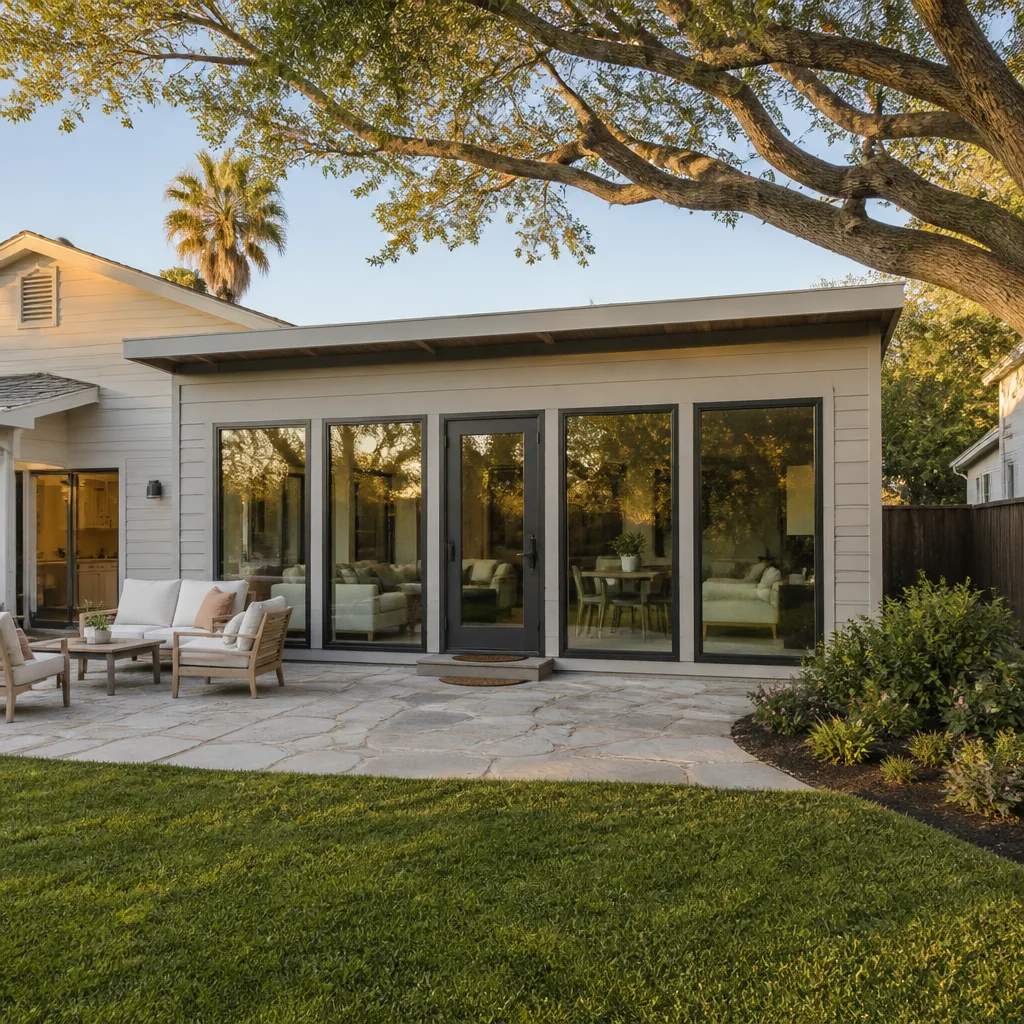
Oldcastle doesn’t sell finished “home addition kits” the way some companies sell prefab sheds. What they do manufacture is the structural backbone: concrete masonry units (CMUs), architectural block, retaining wall systems, precast concrete panels, and paver systems. In Orange County, the most common Oldcastle-sourced additions we work with fall into three categories:
- CMU block additions built with Oldcastle architectural split-face or ground-face block. These show up most often in Anaheim, Santa Ana, and the older ranch neighborhoods of Fullerton. The block face style, color, and texture are specific to the manufacturing lot, which is why matching a 15-year-old addition requires either pulling a sample and having it color-matched, or blending from the current Oldcastle regional plant output.
- Precast panel additions using Oldcastle wall panels. These are less common in single-family residential but appear in some hillside builds in Yorba Linda and Orange Park Acres. If you have one, the critical identifier is the panel stamp or casting mark, usually on an interior wall edge or inside the mechanical chase.
- Oldcastle paver and hardscape tie-ins where an addition’s foundation, patio, or walkway uses Oldcastle pavers. The paver series (Cobble, Holland, or Promenade are the common Orange County lines) determines what you can source for additions or repairs.
For CMU work, the key compatibility gotcha is block module size. Oldcastle architectural block runs on an 8×8×16 nominal module, but the actual face dimensions vary slightly by product line, and the through-body color blend varies by manufacturing plant. A block pulled from the Chandler, Arizona plant won’t be a dead match for one from the Riverside plant, even if the product code is the same. For any Orange County addition that ties into existing Oldcastle block, we pull a physical sample and verify plant-of-origin codes before ordering. That’s the difference between a seam you can see from the sidewalk and a wall that reads as one build.
On the OEM versus aftermarket decision for Oldcastle materials: Oldcastle is the OEM. There’s no meaningful “generic” equivalent for structural CMU because building code approval in Orange County requires the specific product listing. What you can flex on is the accessory hardware: anchor bolts, joint reinforcement, grout mixes, and waterproofing membranes. We spec those from documented brand names (Simpson Strong-Tie for anchors, BASF or W.R. Meadows for waterproofing) rather than whatever is on the shelf. That keeps the warranty chain intact.
Styles & brands we work with







Signs Your Oldcastle Home Additions & ADU Is Failing
Most Orange County homeowners don’t wake up thinking about their addition until something visibly moves, cracks, or leaks. Here are the five things we see most often on service calls, and what’s actually going on behind each one:
- Stair-step cracks in CMU walls near the roofline or corners. This usually means differential settlement or thermal expansion that the mortar joints couldn’t absorb. In Orange County’s clay-heavy soil zones (parts of Orange, Tustin, and Irvine), seasonal moisture swings are a real thing, and they flex foundations more than people expect.
- Efflorescence (white chalky deposits) bleeding through interior or exterior block faces. It’s not structurally urgent, but it tells you water is moving through the wall assembly from the wrong side. On older additions built before modern vapor barriers were standard behind the block, this shows up after every sustained rain cycle.
- Doors and windows in the addition sticking or dragging in their frames. More often than not, it’s not the door, it’s the header or the jamb studs shifting. If the addition was framed with a hip roof and no ridge beam, the roof load pushes the walls outward over time.
- Cold spots or musty smell in the addition, especially near the slab edge. This points to a thermal or moisture break failure at the slab-to-wall transition. Older Oldcastle-sourced additions in Orange County were sometimes built before sill gaskets and capillary breaks were standard practice.
- Sagging or uneven concrete paver tie-ins at the addition’s entry points. The pavers themselves are usually fine. What fails is the sand setting bed and base rock compaction below, especially where irrigation overspray has saturated the area for years.
See the difference
 Before
 After
After Before
 After
After Before
 After
AfterReplacement Cost & What’s Included
For a full-scale home addition in Orange County built with Oldcastle-compatible materials, plan on $45,000 to $130,000. That range covers everything from a clean 400-square-foot single-room bump-out to a larger multi-room addition with structural upgrades. The three biggest cost drivers are foundation type (slab-on-grade is cheaper; raised floor with new footings runs more), roof tie-in complexity (matching an existing gable is straightforward; tying into a hip roof with a new valley adds framing hours), and whether we’re matching existing Oldcastle block or starting fresh.
Every Bradford Remodeling project in Orange County comes with a written line-item price before work starts. That means you see exactly what the block, mortar, grout, rebar, anchor hardware, waterproofing, framing, drywall, electrical rough-in, permit fees, and labor cost – each on its own line. No allowances that quietly become change orders at framing inspection. The 365-Day Done Right Promise covers all of it: if any part of the addition work fails within one year of completion, we return and correct it at no charge. That’s a written guarantee, in your hand, before you sign anything.
| Orange County Addition Project | Typical Installed Range |
|---|---|
| Home Addition (Oldcastle-compatible build) | $45,000 – $130,000 |
| ADU Construction | $90,000 – $220,000 |
| Garage Conversion | $30,000 – $80,000 |
| Concrete Block Wall Repair (per 8-foot section, materials and labor) | $350 – $900 |
DIY or Call Us?
There’s a transparent line between what a homeowner in Orange County can reasonably check on their own and what should never be tackled without a framing crew and a permit. Here’s the straight version.
You can mark cracks with a pencil line and remeasure in 30 days – that tells you whether movement is active or settled. You can check for standing water against the addition’s slab edge after a good rain. You can pull an outlet cover on an exterior wall and look for damp insulation or rust. Those are diagnostic steps any careful homeowner can handle.
What you shouldn’t do is repoint structural CMU yourself, sister a header, cut into a load-bearing wall, or try to stop an active foundation issue with surface patch. Structural work on an addition carries the same building code weight as the original structure. In Orange County, that means the project needs a permit, engineered drawings for anything load-bearing, and an inspection sign-off. When we see DIY structural repairs, we almost always see a second repair bill to undo the first attempt. If the wall cracks are wider than a quarter-inch, or a door frame has gone out of square by more than a half-inch, call (562) 262-2907 before you touch anything – the estimate is free, and you’ll get a straight answer either way.
FAQs
A properly built CMU addition in Orange County’s climate has a structural service life of 60 to 80 years or more, with the mortar joints as the first maintenance item at roughly the 25-to-30-year mark. What shortens that lifespan is water – blocked weep holes, missing flashings, and irrigation against the wall will degrade mortar faster than anything else.
Yes, most stair-step cracking is repairable if the underlying cause is addressed – that means compaction or drainage correction, then repointing and possibly helical tie installation. The repair route only works if the structure is sound; an engineer needs to look at it before anyone grinds out a joint. Call (562) 262-2907 and we’ll bring in the right inspection before recommending anything.
A single-room addition typically runs 10 to 16 weeks from first excavation to final inspection, depending on city permit turnaround – Orange, Anaheim, and Santa Ana each have their own review timelines. Larger additions and ADUs run 4 to 8 months. We’ll put the full schedule in your written estimate, including permit inspection checkpoints.
We keep common Oldcastle architectural block profiles and accessory hardware ordered to spec for each job – we don’t run a warehouse, and for good reason. Color matching requires the exact plant batch, so we order directly from the current manufacturing run to get the closest possible blend. That’s more accurate than stocking leftover material that’s been sun-faded on a yard for eight months.
Written by Curtis Lane, Owner, Bradford Remodeling Co – Orange County at Bradford Remodeling Co Orange County, serving Orange County and nearby areas.
Ready for a straight number on your Orange County addition or ADU project? Call (562) 262-2907 and we’ll put a written line-item price in your hands before any work starts. Straight number, clear scope, no surprises at final invoice.


